
Every list of "fastest-growing app categories" you will find is either someone's revenue forecast or someone's guess. This one is a count. We measured 3M+ listings and asked, for each of the 40 categories, what share of its dated listings was first released in 2026. That is growth you can verify, and it splits the store into a flooded end and a frozen end.
The short answer
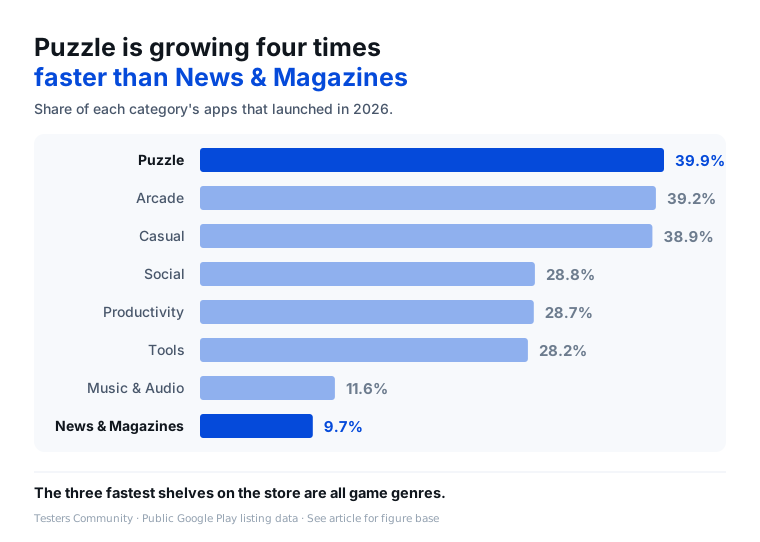
Puzzle is the fastest-growing Google Play category of 2026: 39.9% of its dated listings launched this year, with Arcade at 39.2% and Casual at 38.9% just behind. The fastest non-game shelves are Social, Productivity and Tools, all near 28%. At the other end, News & Magazines refreshed just 9.7% and Music & Audio 11.6%. One caution before you pick a category from this list: growth here means new supply, and new supply is your future competition as much as your market signal.
Which categories are growing fastest?
The top of the ranking is not close. 39.9% of Puzzle's dated listings were first released in 2026, and our data stops at 25 August. Arcade and Casual sit within a point of it. No other category on the store crosses 32%.
For scale, the store as a whole refreshed 21.6% of its dated listings this year. So the three leaders are growing at nearly double the store's own pace. And they are doing it on big shelves: Puzzle alone holds 66,255 listings in our data, and Casual another 57,316.
The fastest non-game categories tell a familiar 2026 story. Social at 28.8%, Productivity at 28.7% and Tools at 28.2% lead the app side. And Productivity and Tools are exactly where the wave of AI assistants, utilities and wrappers lands on Google Play. Business is the store's second-largest category and still refreshed about a fifth of its shelf this year.
Why is the flood a games story?
Every one of the three fastest-growing categories on the store is a game genre, and five of the top eight are. This matches what we found when we asked whether a game is worth building in 2026: games out-perform other apps on every outcome we can measure, and developers have noticed.
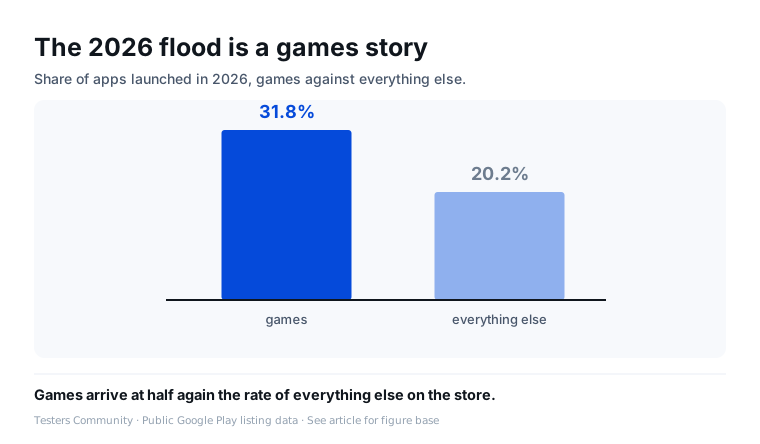
The comparison is blunt. 31.8% of all dated games launched in 2026, against 20.2% of dated non-game apps. And within games, the flood picks the genres with the lowest barrier to entry. Puzzle, Arcade and Casual are the templates, tutorials and asset-store genres, while Simulation and Role Playing, the genres that take longest to build, refreshed about a fifth of their shelves.
Is fast growth good news for you?
Read the ranking both ways before you act on it. The generous reading is that a fast-growing category is attracting new publishers. The ranking shows where supply is increasing; it does not measure whether demand is increasing with it.
The harsh reading is in the same table. 66.0% of Arcade listings are still under 1,000 lifetime installs, the worst share of any category, and Puzzle sits at 56.0%. The fast-growing app shelves are not gentler: 71.1% of Productivity listings are under 1,000, and Social is at 63.4%. Fast growth measures arrivals, not winners, and most arrivals stay small.
Remember what a 2026 launch looks like from the inside. Of this year's releases across the whole store, 84.5% are still under 1,000 installs and 96.4% show no rating yet. A fast-growing category multiplies the number of listings in exactly that state, all competing for the same browse surfaces you are.
How does your category compare?
The full ranking is below: every category's size in our data, its 2026 share of dated listings, and the share of its listings still under 1,000 installs. Read the two percentage columns together. A category like Simulation pairs modest growth with the second-best install odds on the store, while Trivia pairs fast growth with a majority of its shelf stuck.
| Category | Listings in our data | Released in 2026 | Still under 1,000 installs |
|---|---|---|---|
| Puzzle | 66,255 | 39.9% | 56.0% |
| Arcade | 29,094 | 39.2% | 66.0% |
| Casual | 57,316 | 38.9% | 49.2% |
| Strategy | 12,294 | 31.6% | 41.5% |
| Trivia | 9,471 | 29.4% | 55.5% |
| Social | 41,200 | 28.8% | 63.4% |
| Productivity | 186,195 | 28.7% | 71.1% |
| Board | 12,231 | 28.4% | 50.3% |
| Tools | 247,857 | 28.2% | 61.8% |
| Word | 9,330 | 28.2% | 50.1% |
| Video Players & Editors | 10,657 | 28.2% | 35.7% |
| House & Home | 25,344 | 26.0% | 69.7% |
| Sports | 70,866 | 25.3% | 62.2% |
| Action | 17,560 | 24.2% | 43.5% |
| Lifestyle | 167,689 | 23.5% | 68.7% |
| Art & Design | 13,865 | 23.4% | 50.9% |
| Card | 9,676 | 23.3% | 38.0% |
| Events | 22,575 | 22.4% | 76.2% |
| Simulation | 21,880 | 22.2% | 24.0% |
| Finance | 139,812 | 21.6% | 58.3% |
| Business | 276,925 | 21.2% | 74.2% |
| Entertainment | 112,358 | 21.2% | 49.2% |
| Auto & Vehicles | 38,995 | 21.1% | 64.0% |
| Health & Fitness | 163,743 | 20.8% | 76.8% |
| Adventure | 14,472 | 20.7% | 41.2% |
| Role Playing | 13,598 | 20.7% | 21.6% |
| Photography | 21,177 | 20.5% | 38.2% |
| Beauty | 21,368 | 19.5% | 82.6% |
| Maps & Navigation | 40,635 | 18.8% | 58.3% |
| Travel & Local | 88,620 | 18.5% | 61.9% |
| Food & Drink | 175,772 | 18.3% | 79.7% |
| Educational | 18,938 | 17.8% | 51.7% |
| Shopping | 124,947 | 17.8% | 64.6% |
| Communication | 61,134 | 16.1% | 65.4% |
| Education | 337,128 | 14.8% | 63.4% |
| Medical | 41,724 | 13.4% | 61.7% |
| Personalization | 73,247 | 12.6% | 49.6% |
| Books & Reference | 80,980 | 12.3% | 45.4% |
| Music & Audio | 93,953 | 11.6% | 48.5% |
| News & Magazines | 26,064 | 9.7% | 47.4% |
"Released in 2026" is a share of each category's dated listings, because 23.9% of the listings in our data carry no release date. "Still under 1,000 installs" is a share of everything in our data in the category.
What about the slowest shelves?
The bottom of the table is its own finding. News & Magazines refreshed just 9.7% of its dated listings in 2026, and Music & Audio, Books & Reference and Personalization all sit under 13%. Almost nobody is building new apps in these categories, and the shelves show their age: 40.5% of Music & Audio listings have gone over a year without an update, against 28.3% store-wide.
Do not read that as an open door. A slow shelf is mostly an old shelf, and old shelves are full of survivors: only 47.4% of News & Magazines listings are under 1,000 installs, comfortably better than the store's 62.7%. The incumbents you would face there have had years to accumulate installs and ratings, and the lack of new entrants suggests developers see little unclaimed demand is not measured here. Slow growth and fast growth are different supply patterns, neither a verdict on the opportunity for a new app.
Whichever end of the table you launch into, the mechanics of a 2026 release are the same: you arrive unrated on a crowded surface, and the store gives you nothing for free. The five reasons behind that are measured in our study of why apps get few installs, and every one of them applies harder in a category adding new listings at double speed.
About this data
Every figure on this page comes from the Google Play listing database Testers Community has built and maintained since 2024. This 2026 study analyzes 3,037,501 listings observed from 27 July to 25 August 2026. For each of the 40 categories we computed the share of its dated listings first released in 2026, and that share is the "growth" ranked on this page. What counts as an app, what is excluded and how percentages are based is set out in how we count Google Play apps.
Dated listings matter because 23.9% of all listings carry no release date, so every 2026 share on this page uses the smaller, dated base, stated per category in the table. Install figures are the ones shown on the listing.
How to read these findings
- Study population. Every figure is a share of the 3M+ listings in our data, never a share of the whole Play Store, whose total Google does not publish.
- Current study snapshot. Our database has been maintained since 2024. Apps delisted before then are invisible, so each category's 2026 share measures the new supply that survived to August, not everything that launched. Categories that delist aggressively will look slower than they were.
- Supply, not demand. A 2026 share counts new listings, not new users, installs or revenue. A category can add apps faster than it adds customers, and the fast end of this ranking may be doing exactly that.
- Correlation only. Fast-growing categories sit with worse under-1,000 shares. Which causes which is not established here, and both may follow from ease of entry.
- Developer-chosen categories. Each listing's category is picked by its developer, and boundaries like Casual against Arcade are not policed sharply.
Frequently asked questions
Which Google Play category is growing fastest in 2026?
Puzzle, in our 3M+ listing study: 39.9% of its dated listings were first released in 2026, the highest share of the 40 categories we measured. Arcade is second at 39.2% and Casual third at 38.9%, so the three fastest-growing categories on the store are all game genres.
How is category growth measured in this study?
As new supply: the share of each category's dated listings that was first released in 2026, measured in the current study of 3M+ listings observed from 27 July to 25 August 2026. It measures how fast a category's shelf is refreshing with new apps, not how fast its users, installs or revenue are growing. And listings without a release date, 23.9% of the data, are excluded from the base.
Which non-game categories are growing fastest in 2026?
Social, Productivity and Tools, in our data: 28.8%, 28.7% and 28.2% of their dated listings launched in 2026 respectively, all well ahead of the store-wide 21.6%. Productivity and Tools are also two of the store's largest categories, so those shares represent tens of thousands of new listings each.
Which Google Play categories are growing slowest?
News & Magazines is slowest in our data, with 9.7% of its dated listings released in 2026, followed by Music & Audio at 11.6%, Books & Reference at 12.3% and Personalization at 12.6%. These are also among the store's most abandoned shelves, with over 40% of their listings silent for more than a year.
Is a fast-growing category a good place to launch?
Fast growth means more new listings. It measures arrivals, not winners: 66.0% of Arcade listings and 56.0% of Puzzle listings are still under 1,000 installs, and 84.5% of all 2026 releases are too. Compare category size and install distribution as well as its rate of new arrivals.
How many new apps launched on Google Play in 2026?
499,548 of the apps in our data were first released in 2026, and our data stops at 25 August, which works out to roughly 2,100 new apps a day. That is 21.6% of all dated listings in our data, already ahead of the whole of 2025.
Do slow-growing categories mean less competition?
Not necessarily. News & Magazines has fewer recent entrants, but only 47.4% of its listings are under 1,000 installs, compared with 62.7% across our study. Its observed listings are more established; a lower arrival rate alone does not measure the difficulty a new app will face.
Citing this research
The Google Play listing database behind this paper has been built and maintained by Testers Community since 2024. Testers Community, Puzzle Leads Google Play’s 2026 Influx of New Listings, August 2026. Based on 3,037,501 listings in the current study, observed from 27 July to 25 August 2026, with category growth measured as the share of each category's dated listings first released in 2026. When you quote a figure, keep the base and the date range with it, because both change what the number means.
Copy a reference
- Plain
- Testers Community (2026). Puzzle Leads Google Play’s 2026 Influx of New Listings. https://www.testerscommunity.com/research/fastest-growing-categories
- APA 7
- Testers Community. (2026, October 7). Puzzle Leads Google Play’s 2026 Influx of New Listings. https://www.testerscommunity.com/research/fastest-growing-categories
- MLA 9
- “Puzzle Leads Google Play’s 2026 Influx of New Listings.” Testers Community, 7 Oct. 2026, www.testerscommunity.com/research/fastest-growing-categories.
- In an article
- according to Testers Community’s analysis of 3,037,501 Google Play listings (August 2026)
- HTML link
<a href="https://www.testerscommunity.com/research/fastest-growing-categories">Testers Community, Puzzle Leads Google Play’s 2026 Influx of New Listings</a>
Reuse the figures and the table. Everything on this page is free to republish under CC BY 4.0. Keep the source line that is drawn on each figure, and link this page as the source. Each element has its own address so you can point at exactly what you quote: figure 1, figure 2 and the data table.
Need a different cut of the data, a comment for an article, or a figure sized for your page? Write to support@testerscommunity.com and say which page you are citing.
Sources
- Choose a category and tags for your app or game, Google Play Console Help
- Publish your app, Google Play Console Help