
Ask around and you will hear that the mobile game market is saturated, hit-driven and not worth entering. We measured 3M+ listings, 312,795 of them games, and the picture is more precise than that. Games out-perform other apps on every outcome we can measure. They also pay for it in three specific ways, and one of them is your choice of genre.
The short answer
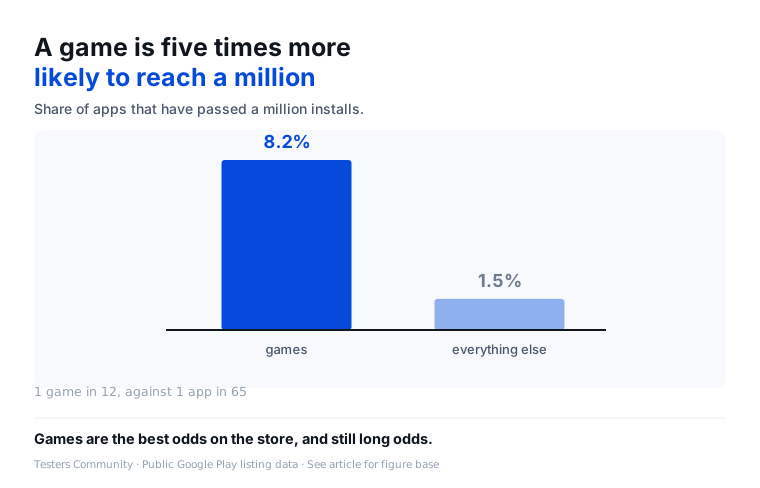
In the listings we observed, 8.2% of games show one million or more installs, versus 1.5% of other apps. That is a fivefold difference in current prevalence, not a forecast for a new title. Games also face faster listing growth, an ads-heavy business model and large differences by genre.
Do games really outperform apps?
At every install band, yes. Of the 312,795 games in our data, 8.2% have passed one million lifetime installs. Of the 2,724,706 other apps, 1.5% have. That is a 5x gap at the top, and it holds at the bottom too: 47.2% of games are still under 1,000 installs against 64.5% of other apps.
For context, the store baseline is bleak. The typical app across all 3M+ listings sits at 100 to 499 lifetime installs, and 627 of every 1,000 never pass 1,000. Games are not exempt from that gravity. They just fight it visibly better, band by band.
The gap is not only installs. 27.1% of games show a star rating against 10.5% of other apps, in a store where most listings show none. Games are also abandoned barely half as often: 17.0% have gone a year without an update, against 29.6% of everything else.
Why do games pull ahead?
The data establishes the gap, not its cause. Game listings also carry more detail: the typical game ships 12 screenshots where other apps ship 7. And the same gap runs through descriptions and videos.
Read that carefully. It does not prove that effort causes installs, and it does not prove that building a game will grow faster than building an app. Successful titles can afford fuller pages. What it does tell you is the bar: if you ship a game with 4 screenshots and no video, you are below the typical standard for its own shelf, not just below the winners.
What does building a game cost you?
Two things show up in the same data, and you should price both in before you open the engine.
First, the flood is faster on the games side. 31.8% of the dated games in our data were first released in 2026, against 20.2% of dated non-game apps. Whatever advantage games show in outcomes, more developers are arriving to contest it, and they are arriving now.
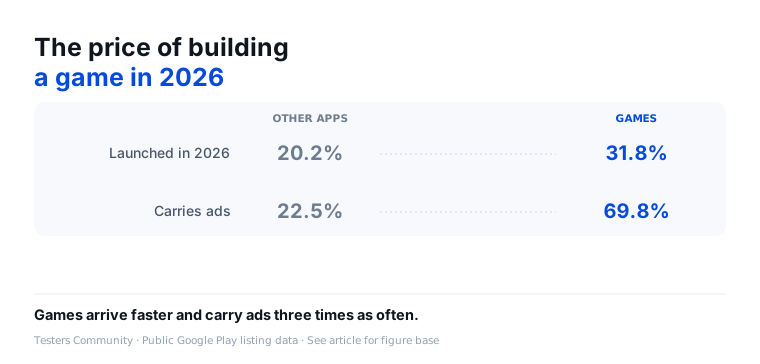
Second, the economy is ads-first. 69.8% of games declare ads, against 22.5% of other apps. If you want to build a game and never touch ad networks, you are choosing a business model that only 3 in 10 of your shelf-mates use. Possible, but you should know you are in the minority before you start.
Which genre should you pick?
This is where the averages stop helping, because the 12 genres we measured are barely the same market. The honest difficulty metric is the share of a genre's games still under 1,000 installs, and it runs from 21.6% to 66.0%.
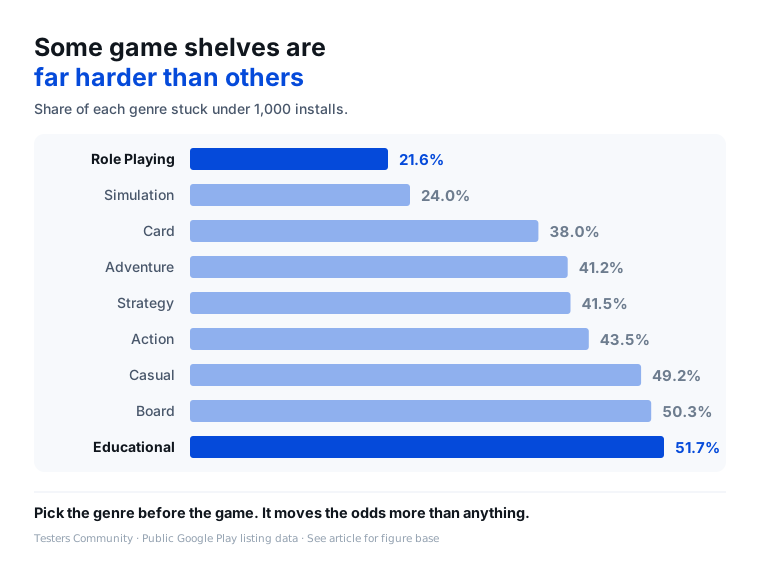
The pattern is consistent: the genres that are easiest to build are the hardest to grow in. Arcade is the worst room, with 66.0% of its 29,094 games under 1,000 installs and 39.2% of its dated titles launched this year. Puzzle pairs a 56.0% stuck rate with the fastest flood of all, 37.1% launched in 2026 across 66,255 listings.
At the other end sit the genres that take longer to ship. Only 21.6% of the 13,598 Role Playing games are under 1,000 installs, and only 15.7% of its dated titles launched this year. Simulation reads the same way: 24.0% stuck, 19.6% new. In this dataset, genres with more new listings also have more apps stuck below 1,000 installs.
| Genre | Games in our data | Launched in 2026 | Still under 1,000 installs |
|---|---|---|---|
| Role Playing | 13,598 | 15.7% | 21.6% |
| Simulation | 21,880 | 19.6% | 24.0% |
| Card | 9,676 | 20.9% | 38.0% |
| Adventure | 14,472 | 18.5% | 41.2% |
| Strategy | 12,294 | 27.4% | 41.5% |
| Action | 17,560 | 22.2% | 43.5% |
| Casual | 57,316 | 35.2% | 49.2% |
| Board | 12,231 | 26.0% | 50.3% |
| Educational | 18,938 | 15.6% | 51.7% |
| Trivia | 9,471 | 26.3% | 55.5% |
| Puzzle | 66,255 | 37.1% | 56.0% |
| Arcade | 29,094 | 39.2% | 66.0% |
What can this data support?
If the question is "do games do better than apps on Google Play", our data answers yes on every measure we have. If the question is "will my game do better than my app idea", no dataset can answer that, and this one does not try. What it can do is set the conditions.
Build it knowing the field refreshes faster than the app side, a third of it this year. Build it knowing the default business model is ads, and decide yours on purpose. And pick the room before you pick the game: the spread between Arcade at 66.0% stuck and Role Playing at 21.6% is wider than the entire games-versus-apps gap.
One more condition is set by Google, not by the market. If you publish from a new personal account, your game cannot go to production until a closed test has run with 12 opted-in testers for 14 continuous days. Treat that as the rehearsal: two weeks of real players finding the bugs, the difficulty spikes and the confusing first minute while fixing is still cheap.
About this data
Every figure on this page comes from the Google Play listing database Testers Community has built and maintained since 2024. This 2026 study analyzes 3,037,501 listings observed from 27 July to 25 August 2026. Of those, 312,795 sit in game categories, 10.3% of all listings. Every figure above is computed over those listings. What counts as an app, what is excluded and how percentages are based is set out in how we count Google Play apps.
"Launched in 2026" shares are computed over listings that carry a release date, which not all do, so we say "dated games" wherever that base applies. Ads and in-app purchase figures are the declarations shown on the listing, not measurements of revenue.
How to read these findings
- Study population. Every figure is a share of the 3M+ listings in our data, never a share of the whole Play Store, whose total Google does not publish.
- Current study snapshot. Our database has been maintained since 2024. We measured every app once, in one window. Nothing here tracks a game through time.
- Correlation only. Games sit with better outcomes. That does not mean building a game causes better outcomes.
- Revenue scope. Listing install counts and ads declarations do not measure earnings.
- No ranking or search data. Google Play exposes neither, so this study cannot say what gets discovered, only what exists.
- Survivorship in old launch classes. Games that were delisted before then are missing, which makes the older, calmer genres look somewhat better than their full launch classes did.
Frequently asked questions
Is it worth building a mobile game in 2026?
On the outcomes we can measure across 3M+ listings, yes: games pass 1 million installs at 8.2% against 1.5% for everything else, and lead on every other outcome too. The price is a faster flood of rivals, an ads-first economy, and odds that swing hard by genre. The data shows association, not proof that building a game causes success.
Do games get more installs than other apps?
In our data, yes, at every band: 8.2% of the 312,795 games pass 1 million installs against 1.5% of other apps. And games are stuck under 1,000 installs far less often, 47.2% against 64.5%.
How many mobile games pass 1 million installs?
8.2% of the 312,795 games in our data have passed 1 million lifetime installs, about 1 game in 12. For non-game apps the figure is 1.5%, so games cross that line at roughly 5x the rate.
Which game genre is hardest to grow in?
Arcade, in our data: 66.0% of the 29,094 Arcade games in our data are still under 1,000 installs, the worst share of the 12 genres we measured. And 39.2% of dated Arcade games launched in 2026. Puzzle and Trivia are close behind at 56.0% and 55.5% under 1,000.
Which game genre has the best install odds?
Role Playing, in our data: only 21.6% of the 13,598 Role Playing games in our data are still under 1,000 installs, the best share of the 12 genres we measured. Simulation is next at 24.0%, and both genres also see far less new competition, with under 20% of their dated titles launched in 2026.
How crowded is the mobile game market in 2026?
Crowded and getting faster: 31.8% of the dated games in our data were first released in 2026, against 20.2% of dated non-game apps. The flood is uneven, though. Over 35% of dated Puzzle, Casual and Arcade games launched this year, against under 20% of Simulation and Role Playing games.
How do mobile games monetize in 2026?
Mostly with ads: 69.8% of the games in our data declare ads, against 22.5% of other apps. 30.8% of games offer in-app purchases against 9.2% of other apps, and only 4.3% are paid up front. These are declarations on the listing, not revenue figures.
Do you need testers before launching a game?
If you publish from a new personal Google Play account, yes: Google requires a closed test with 12 opted-in testers running for 14 continuous days before you can apply for production access. That applies to games and apps alike, and it is the one built-in rehearsal every new developer gets before the store sees the game.
Citing this research
The Google Play listing database behind this paper has been built and maintained by Testers Community since 2024. Testers Community, Is It Worth Building a Game in 2026?, August 2026. Based on 3,037,501 Google Play listings in the current study, observed from 27 July to 25 August 2026, of which 312,795 are games. When you quote a figure, keep the base and the date range with it, because both change what the number means.
Copy a reference
- Plain
- Testers Community (2026). Games Are 5× as Likely to Show 1M+ Installs. https://www.testerscommunity.com/research/is-it-worth-building-a-game-in-2026
- APA 7
- Testers Community. (2026, October 7). Games Are 5× as Likely to Show 1M+ Installs. https://www.testerscommunity.com/research/is-it-worth-building-a-game-in-2026
- MLA 9
- “Games Are 5× as Likely to Show 1M+ Installs.” Testers Community, 7 Oct. 2026, www.testerscommunity.com/research/is-it-worth-building-a-game-in-2026.
- In an article
- according to Testers Community’s analysis of 3,037,501 Google Play listings (August 2026)
- HTML link
<a href="https://www.testerscommunity.com/research/is-it-worth-building-a-game-in-2026">Testers Community, Games Are 5× as Likely to Show 1M+ Installs</a>
Reuse the figures and the table. Everything on this page is free to republish under CC BY 4.0. Keep the source line that is drawn on each figure, and link this page as the source. Each element has its own address so you can point at exactly what you quote: figure 1, figure 2, figure 3 and the data table.
Need a different cut of the data, a comment for an article, or a figure sized for your page? Write to support@testerscommunity.com and say which page you are citing.
Sources
- Choose a category and tags for your app or game, Google Play Console Help
- Paid apps, in-app products & subscriptions, Google Play Console Help