
You created a Google Play developer account and met a rule the older tutorials never mention: your app cannot go to production until a closed test has run with 12 opted-in testers for 14 continuous days. This page is about that fortnight, and about the store waiting on the other side of it. We measured 3M+ listings, and what they show changes how the rule reads. It is not a delay. It is the one advantage a new account gets.
The short answer
A new developer faces a gate and a flood: a closed test with 12 opted-in testers running for 14 continuous days before you can apply for production access, and about 2,100 new apps arriving every day. Of the apps launched in 2026, 964 of every 1,000 show no rating. Only the gate works in your favour. It is a forced rehearsal with real users, run at the exact moment changing things is still cheap.
What does Google actually require?
If you created a personal developer account after 13 November 2023, you must run a closed test before your first production release. The test needs 12 testers opted in, and it must run for 14 continuous days. Only then can you apply for production access.
The rule has already softened once. It launched in November 2023 demanding 20 testers, and Google cut the number to 12 in late 2024. The 14 days never changed.
Two details save developers the most confusion. First, dropping below 12 testers does not reset the 14-day timer; weak engagement is judged later, at production review, not by the clock. Second, 12 is a floor, not a target. Nothing stops you running more, and the rehearsal argument below is a reason to.
What store are you launching into?
Now the other side of the gate. 499,548 of the apps in our data were first released in 2026, and our data stops at 25 August. That is about 2,100 new apps a day, already more than the whole of 2025 with four months to spare.
Almost all of those launches are silent. Of the apps released in 2026, 964 of every 1,000 show no rating, because Google Play only displays a score once enough ratings have accumulated. A new listing starts with no stars, and most stay that way for a long time.
The table below compares surviving listings by release year. Newer cohorts have a larger share under 1,000 lifetime installs, and 45.5% of the observed 2021 cohort remains below that threshold. These rows compare different apps rather than following one app over time.
| Launch year | Apps released | Still under 1,000 installs today |
|---|---|---|
| 2021 | 153,630 | 45.5% |
| 2022 | 203,635 | 55.3% |
| 2023 | 252,564 | 59.1% |
| 2024 | 260,003 | 64.8% |
| 2025 | 399,738 | 72.3% |
| 2026 (to 25 Aug) | 499,548 | 84.5% |
Shares are computed over the 2,311,689 listings that carry a release date. And they flatter reality: apps delisted before then are missing, and delisted apps did not leave because they were thriving. This is the launch class gravity a new launch has to escape, and our study of why apps get few installs takes it apart reason by reason.
Why the fortnight is an advantage
Put the two halves together. The store punishes cold launches, and the pattern sets in early. The one thing a new account is guaranteed before its page goes public is 14 days of real users: mandated, scheduled, and impossible to skip.
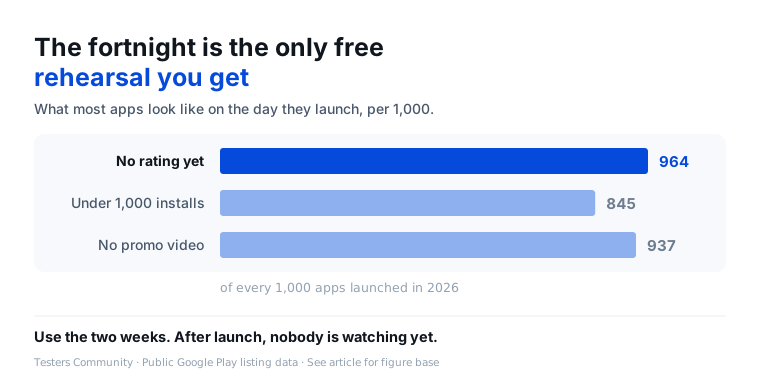
That is a rehearsal, and nothing else on this page works for you the way it does. Exempt accounts can launch cold, straight into the flood. You cannot, which means your crashes, your confusing first screen and your broken onboarding get found by 12 people who opted in, not by strangers whose first impression is also their last.
It is also the cheapest fixing window your app will ever have. Nothing is public and no rating is at stake, so a bad build costs you a new upload instead of a bad review. Developers who treat the fortnight as a countdown spend it waiting. The ones who treat it as a test spend it shipping fixes to a live audience.
How long does the full gate take?
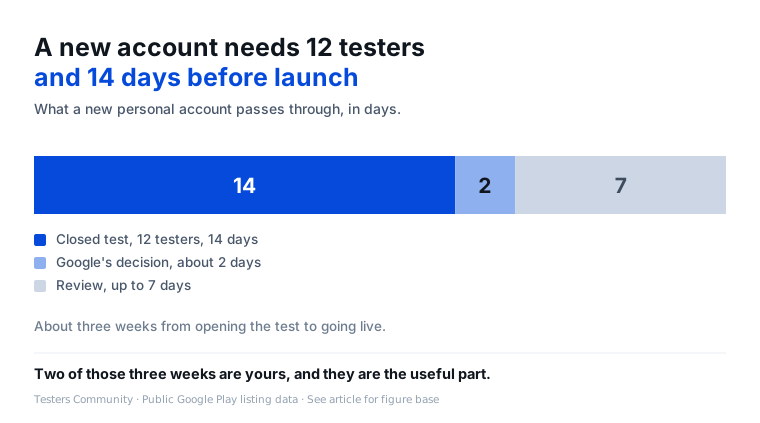
The 14 days are the longest stage, but not the whole gate. When the test completes, you apply for production access through a form with 10 questions. The decision on that application takes about 48 hours.
Clear it, and your production release still goes through review, which takes up to 7 days. Add the stages up and a first launch from a new personal account runs about three weeks end to end, when every stage passes first time.
Plan backwards from that. If you have a launch date, the test needs to start about three weeks earlier, with the testers already opted in. Because the clock does not start until the test is live with them in it.
Who is exempt from the rule?
Two groups skip the gate entirely: organisation accounts, and personal accounts created before 13 November 2023. If that is you, nothing above is mandatory.
The store data does not change for exempt accounts, though. The flood, the silent launches and the launch class gravity apply to every release, which is why plenty of exempt developers run the same closed test by choice. The rehearsal is the useful part. The mandate just makes sure new accounts do not skip it.
About this data
Every figure on this page comes from the Google Play listing database Testers Community has built and maintained since 2024. This 2026 study analyzes 3,037,501 listings observed from 27 July to 25 August 2026. Release-year and launch-class figures are computed over the 2,311,689 listings with a date, and we say so wherever that base applies. Install counts are the ones shown on the listing. What counts as an app, what is excluded and how percentages are based is set out in how we count Google Play apps.
The policy facts are Google's, not ours. The tester count, the 14 days, the form length and the review windows come from Google Play Console's published requirements, and Google can change them. The store figures are ours, measured once, in that window.
How to read these findings
- Study population. Every figure is a share of the 3M+ listings in our data, never a share of the whole Play Store, whose total Google does not publish.
- Current study snapshot. Our database has been maintained since 2024. Cohort figures compare apps of different ages today; they do not track one set of apps through time. Delisted apps are missing, which makes the older launch classes look better than their full launch classes did.
- Nothing measures the test itself. Google Play does not expose closed testing status. So this study cannot say how many accounts pass the gate, or how tested launches perform against exempt ones. The rehearsal argument is an argument, not a measured outcome.
- Correlation only. Where launch-year launch classes sit with lower installs, age and installs are associated. Which causes which is not established here, and we say so wherever it comes up.
- Policy can move. The requirement has changed once already, from 20 testers down to 12. Check the Play Console for the current numbers before you plan around this page.
Frequently asked questions
How many testers does Google Play require in 2026?
12 opted-in testers for 14 continuous days, for personal developer accounts created after 13 November 2023. The requirement launched in November 2023 at 20 testers, and Google reduced it to 12 in late 2024. Organisation accounts and older personal accounts are exempt.
Does dropping below 12 testers reset the 14 days?
No. The 14-day timer keeps running if a tester drops out. Weak engagement is judged later, at production review, not by the clock. Treat 12 as a floor, not a target, and keep spares opted in anyway.
Who is exempt from the 12-tester requirement?
Organisation accounts, and personal accounts created before 13 November 2023. Every personal account created after that date must run a closed test with 12 opted-in testers for 14 continuous days before applying for production access.
How long does production access take after the test?
About 48 hours for the access decision, then production review of the release itself, which takes up to 7 days. You apply through a form with 10 questions once the 14 days complete, so the whole gate runs about three weeks end to end.
How many new apps launch on Google Play every day?
About 2,100 a day in 2026, based on our data: 499,548 of the 3M+ observed listings were first released in 2026, and our data stops at 25 August. That already beats the whole of 2025, which produced 399,738.
Do new Google Play apps launch with ratings?
Mostly no: 964 of every 1,000 apps launched in 2026 show no rating in our data. Google Play only displays a score once enough ratings accumulate, so a silent page is the normal starting state of a new app, not a fault in yours.
Is the 14-day closed test just a delay?
For eligible new personal accounts, Google requires a closed test with 12 opted-in testers for 14 continuous days before a production-access application. Use that period to gather feedback, test important flows and fix issues before publication.
Citing this research
The Google Play listing database behind this paper has been built and maintained by Testers Community since 2024. Testers Community, What Google Play’s 12-Tester Rule Means for New Developers, August 2026. Based on 3,037,501 Google Play listings in the current study, observed from 27 July to 25 August 2026, read against Google Play's published testing requirements as of that date. When you quote a figure, keep the base and the date range with it, because both change what the number means.
Copy a reference
- Plain
- Testers Community (2026). What Google Play’s 12-Tester Rule Means for New Developers. https://www.testerscommunity.com/research/the-12-tester-era
- APA 7
- Testers Community. (2026, October 7). What Google Play’s 12-Tester Rule Means for New Developers. https://www.testerscommunity.com/research/the-12-tester-era
- MLA 9
- “What Google Play’s 12-Tester Rule Means for New Developers.” Testers Community, 7 Oct. 2026, www.testerscommunity.com/research/the-12-tester-era.
- In an article
- according to Testers Community’s analysis of 3,037,501 Google Play listings (August 2026)
- HTML link
<a href="https://www.testerscommunity.com/research/the-12-tester-era">Testers Community, What Google Play’s 12-Tester Rule Means for New Developers (2026)</a>
Reuse the figures and the table. Everything on this page is free to republish under CC BY 4.0. Keep the source line that is drawn on each figure, and link this page as the source. Each element has its own address so you can point at exactly what you quote: figure 1, figure 2 and the data table.
Need a different cut of the data, a comment for an article, or a figure sized for your page? Write to support@testerscommunity.com and say which page you are citing.
Sources
- App testing requirements for new personal developer accounts, Google Play Console Help
- Set up an open, closed, or internal test, Google Play Console Help