
Ask how many apps are on Google Play and the published answers disagree by almost 2 million. A widely repeated tracker figure says about 1.58 million after Google's quality cleanups. Other published estimates run as high as 3.5 million, and none of them shows a method. Testers Community has built and maintained its own Google Play listing database since 2024. The current study analyzed 3,037,501 distinct listings. Our methodology defines the study window, population and counting rule behind that figure.
The short answer
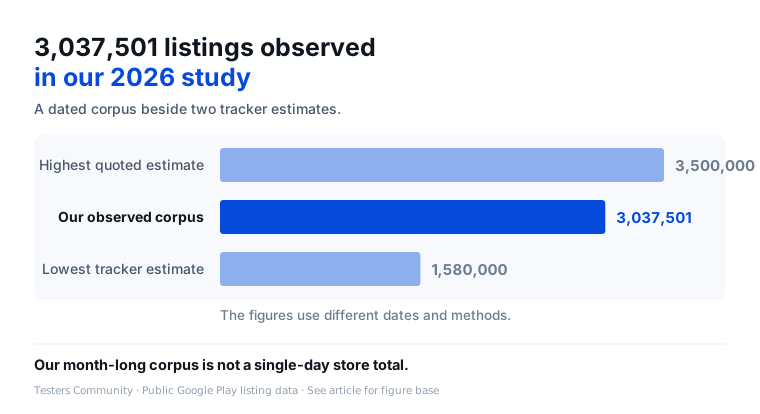
Our database has been built and maintained since 2024. The current study analyzes 3,037,501 distinct listings in a defined study window. Published tracker estimates range from about 1.58 million to 3.5 million, but use different dates and methods. Our figure is a dated corpus, not a simultaneous total for Google Play.
So how many apps are on Google Play?
Our study contains 3,037,501 distinct app listings observed from 27 July to 25 August 2026.
Google Play publishes no complete directory of its apps. Apps we did not discover are not in our corpus, and the month-long observation window does not establish how many were live on one day.
Google itself has not published a store-wide total in years. Every count you have seen, including this one, comes from somebody's dataset, which is exactly why the numbers disagree so badly. That disagreement is worth understanding before you cite any of them.
Why do published counts disagree?
The gap between the smallest and largest published figures is almost 2 million apps. Three things produce it, and none of them requires anyone to be lying.
Cleanup waves move the floor. Google has spent recent years raising its minimum quality bar and removing apps that fall below it, in large batches. A count taken after a sweep can be far smaller than one taken before it. So two honest counters working a year apart can both be right about their own window.
Reach differs. With no public index, every tracker maintains its own list of apps to check, built from charts, search surfaces and years of accumulated discovery. A tracker with a shallower list reports a smaller store. Our count landing well above the lowest estimate proves at least this much: 3M+ listings were individually reachable in our window.
"An app" is not one thing. Counts differ on whether they include listings visible in only some countries and listings that have not been updated in years. In our data, 283 of every 1,000 listings have gone over a year without an update, and the single largest publisher account holds 10,985 apps. Keeping or dropping such listings moves a total by hundreds of thousands.
Here is every figure this page has mentioned, with the honest label for each.
| The figure | What it is | As of | Method published |
|---|---|---|---|
| ~3,500,000 apps | Older published estimates, still widely quoted | Various, often undated | No |
| 3,037,501 listings | Distinct listings observed during our study window | 27 July to 25 August 2026 | Yes, definitions published |
| ~1,580,000 apps | Published tracker estimate, derived from 42matters data, after Google's cleanups | September 2025 | No |
| 1,249 new apps per day | Widely repeated launch-rate figure | Undated | No |
| ~2,100 new apps per day | Our 2026 launch rate, from listing release dates | 1 January to 25 August 2026 | Yes, definitions published |
How fast is the store growing?
Whatever the true total is, the arrival rate is measurable from our data. Of the listings that carry a release date, 499,548 were first released in 2026, and our data stops at 25 August. That is roughly 2,100 new apps every day.
Set that against the launch-rate statistic you will find repeated across the web, which says 1,249 new apps arrive per day. It is a published tracker estimate with no date and no method attached. Our 2026 figure is about 70% higher, and it comes with both.
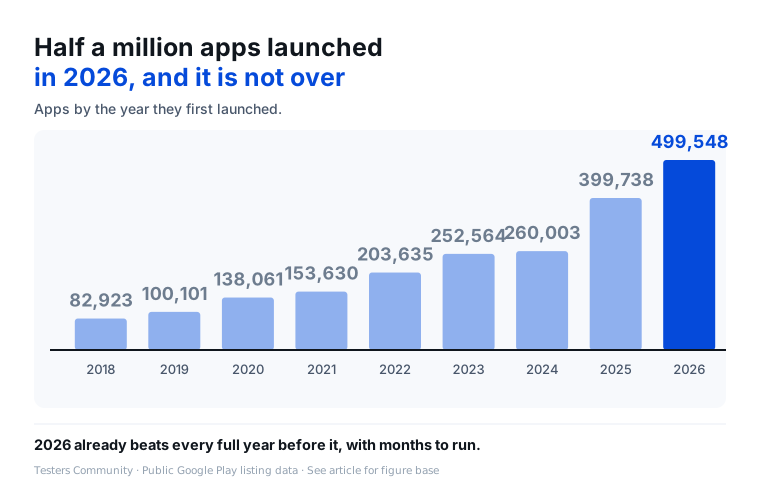
The longer trend is steep: dated releases grew from 49,713 in 2016 to 399,738 in 2025. This year passed the whole of last year with four months to spare.
One caveat belongs under every bar. These figures are computed over the 2,311,689 listings with a release date, not all listings, because 23.9% of the apps in our data carry no date we could read.
And be careful reading growth into this. Our snapshot shows when today's live apps launched, not how many launched each year and survived. Apps removed before then are invisible, and cleanup waves remove them in bulk, so the store's total can shrink even while launches accelerate.
How should you cite these numbers?
Cite each figure with three things attached: who counted, when, and what they counted. "Google Play has 1.58 million apps" is not a fact. "A published tracker estimate put the store at about 1.58 million apps in September 2025, after Google's quality cleanups" is.
Cite ours the same way: Testers Community analyzed 3,037,501 distinct Google Play listings observed between 27 July and 25 August 2026. Do not turn that dated corpus into a single-day store total. Any Play Store count needs its window and method attached.
And before you cite a total at all, ask whether you need it. Most practical questions, how crowded a category is, what a normal app achieves, how fast rivals arrive, are answered by composition rather than size. That is what the rest of our Google Play research measures.
About this data
Every figure on this page comes from the Google Play listing database Testers Community has built and maintained since 2024. This 2026 study analyzes 3,037,501 listings observed from 27 July to 25 August 2026. Each app is counted once. What counts as an app, what is excluded and how percentages are based is set out in how we count Google Play apps.
Release-year figures use a smaller base, the 2,311,689 listings with a release date, and we say "dated listings" wherever that applies. The public estimates quoted on this page are exactly that, published tracker estimates. We reproduce them for comparison and cannot audit them.
How to read these findings
- Not the whole store. Google Play has no complete public index. Apps outside our discovery sources are not counted, and the 30-day corpus is not a single-day total.
- One window. The store changed while we counted it. Apps launched and apps were removed during our 30 days, so any single total is already stale the day it is published, ours included.
- Delisted apps are invisible. Removals do not leave a page behind, so our snapshot cannot measure Google's cleanups directly, only the store that remains after them.
- A listing is not a business. Our count treats an abandoned app, a white label clone and a thriving product as one listing each. Composition matters more than the total, and it is measured in our other research, not settled by this number.
- Public estimates cannot be audited. The tracker figures we quote publish no method, so our three explanations for the disagreement are candidate causes, not established ones.
- Dated figures use a smaller base. Release-year counts cover the 2,311,689 dated listings, because 23.9% of all listings has no date.
Frequently asked questions
How many apps are on Google Play in 2026?
Our study analyzed 3,037,501 distinct Google Play listings observed between 27 July and 25 August 2026. That is a dated research corpus, not a simultaneous total for the whole store. Google does not publish an official total.
Why do Google Play app counts disagree?
Because there is no official number to agree on: Google publishes no total, so every figure comes from somebody's dataset. Counts then diverge for three reasons: they were taken before or after Google's cleanup waves, their trackers reach different sets of apps. And they define "an app" differently, for example including or excluding older, long-unupdated listings.
Is the 1.58 million Google Play app count accurate?
It is a published tracker estimate from September 2025, derived from 42matters data. Its method is not published alongside the figure, and it measures a different date and dataset from ours. Cite it as that tracker's estimate, not an official Google Play total.
How many new apps are added to Google Play every day?
About 2,100 a day in 2026, in our data: 499,548 dated listings were first released in 2026, and our data runs to 25 August. The widely repeated figure of 1,249 new apps per day is a published tracker estimate with no date or method attached.
Does Google publish how many apps are on the Play Store?
No. Google has not published a store-wide app count in years, and Google Play exposes no public index to count from. Every figure in circulation, including ours, is a count of the store's reachable surface, which is why an honest citation always names who counted, when, and how.
Is Google Play growing or shrinking?
Both readings are defensible, which is exactly the problem with citing one number. Launches are accelerating: 2026 produced 499,548 dated releases by 25 August, ahead of all of 2025. But Google's quality cleanups remove apps in large waves, and removals are invisible to a snapshot like ours, so the total can fall even while launches rise.
How should I cite a Google Play app count?
Name the publisher, dataset and observation window. For this study: Testers Community analyzed 3,037,501 distinct Google Play listings observed between 27 July and 25 August 2026. Do not present that figure as a single-day or official store total.
Citing this research
The Google Play listing database behind this paper has been built and maintained by Testers Community since 2024. Testers Community, We Analyzed 3 Million Google Play Listings in 2026, August 2026. Based on 3,037,501 Google Play listings in the current study, observed from 27 July to 25 August 2026. When you quote the count, keep the observation window with it rather than treating it as a single-day total.
Copy a reference
- Plain
- Testers Community (2026). We Analyzed 3 Million Google Play Listings in 2026. https://www.testerscommunity.com/research/how-many-apps-on-google-play
- APA 7
- Testers Community. (2026, September 16). We analyzed 3 million Google Play listings in 2026. https://www.testerscommunity.com/research/how-many-apps-on-google-play
- MLA 9
- “We Analyzed 3 Million Google Play Listings in 2026.” Testers Community, 16 Sept. 2026, www.testerscommunity.com/research/how-many-apps-on-google-play.
- In an article
- according to Testers Community’s analysis of 3,037,501 Google Play listings (August 2026)
- HTML link
<a href="https://www.testerscommunity.com/research/how-many-apps-on-google-play">Testers Community, We Analyzed 3 Million Google Play Listings in 2026</a>
Reuse the figures and the table. Everything on this page is free to republish under CC BY 4.0. Keep the source line that is drawn on each figure, and link this page as the source. Each element has its own address so you can point at exactly what you quote: figure 1, figure 2 and the data table.
Need a different cut of the data, a comment for an article, or a figure sized for your page? Write to support@testerscommunity.com and say which page you are citing.
Sources
- Metadata, Google Play Console Help
- Publish your app, Google Play Console Help