
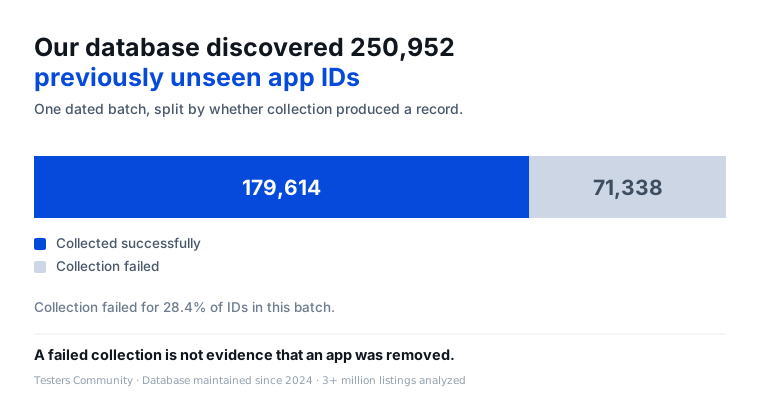
The Testers Community database, maintained since 2024, found 250,952 previously unseen Google Play app IDs in one dated batch. This is a discovery count, not a launch count. Collection produced 179,614 listing records and failed to produce a record for 71,338 IDs.
The finding
One dated batch contained 250,952 previously unseen app IDs. Of those IDs, 179,614 produced listing records and 71,338 did not, a collection-failure share of 28.4%. This single batch does not establish a typical weekly rate, and a failed collection does not establish that an app was removed.
Discovery is not launch
The database discovers app IDs by comparing a dated source of Google Play IDs with the historical set it has already seen. An ID in the difference is new to our database. That rule says when we first found the identifier. It does not say when the developer submitted, published or launched the app.
The records confirm why the distinction matters. Among the 179,614 successfully collected listings, 119,201 carried a release date in July or August 2026 and 122,714 carried a 2026 date of any month. Another 48,013 had no release date, while a smaller tail carried dates before 2026. The batch therefore mixes recent releases, older listings discovered late and records whose launch timing cannot be determined from the saved field.
This is also why we do not generalize the 250,952 figure into “apps per week.” Only one comparable local batch is available for this analysis. A typical weekly rate would require several batches collected with the same rules and a stated averaging method.
What collection failed means
The batch state reports two outcomes. A successful collection saved a listing record. A failed collection did not. The counters are 179,614 successful records and 71,338 failures, which sum to the 250,952 discovered IDs.
The available aggregate does not classify the 71,338 failures by cause. It therefore cannot support claims that those apps were delisted, removed by developers, removed for policy reasons or unavailable in a particular market. The defensible statement is narrower: collection failed for 28.4% of the IDs in this batch.
Safe wording for citation: “Testers Community discovered 250,952 previously unseen Google Play app IDs in the batch dated 23 August 2026. It collected 179,614 records; collection failed for 71,338.”
What the collected records contain
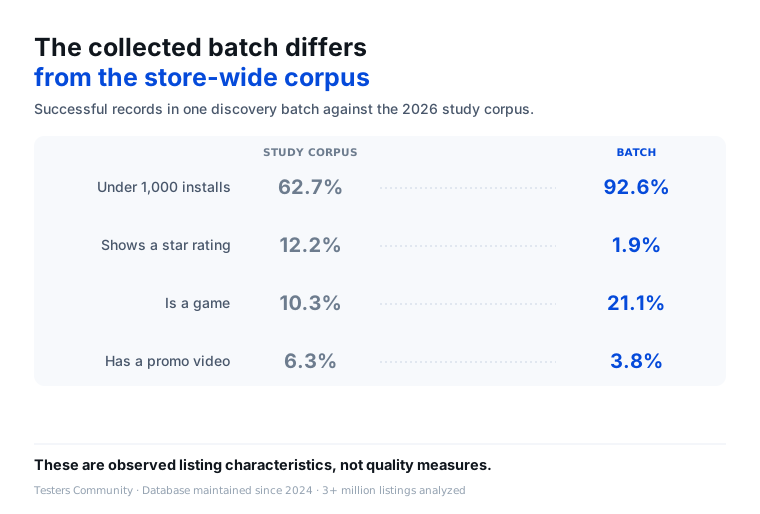
The next comparison uses only the 179,614 successfully collected records. It compares their observed listing fields with the 3,037,501-record store-wide study corpus. It does not compare app quality, future growth or launch performance.
| Observed measure | Discovery batch 179,614 records |
Study corpus 3,037,501 records |
|---|---|---|
| Under 100 lifetime installs | 83.8% | 36.4% |
| Under 1,000 lifetime installs | 92.6% | 62.7% |
| Shows a star rating | 1.9% | 12.2% |
| In a game category | 21.1% | 10.3% |
| Contains ads | 28.9% | 27.3% |
| Offers in-app purchases | 15.5% | 11.4% |
| Links a promo video | 3.8% | 6.3% |
| Carries an upfront price | 1.9% | 2.6% |
| Median description length | 1,245 characters | 774 characters |
| Median screenshots | 7 | 7 |
| Median declared permissions | 7 | 10 |
The largest differences are descriptive. In the batch, 92.6% of collected records were under 1,000 lifetime installs, 1.9% showed a rating and 21.1% belonged to a game category. Those facts do not tell us what will happen to the listings later. They describe the fields at collection time.
Listing characteristics, not quality
The median collected record had a 1,245-character description, 7 screenshots and 7 declared permissions. In the store-wide corpus, the corresponding medians were 774 characters, 7 screenshots and 10 declared permissions.
These measures describe how much text and media was present and how many permissions were declared. They do not measure whether the copy was accurate, the screenshots were persuasive, the permissions were justified or the app was well built. A longer description is not a quality score.
Publishers represented in the batch
The 179,614 collected records contained 115,992 publisher IDs. The median publisher ID appeared once in the batch. A small number appeared many times, including three Owner.com accounts with 1,181 records between them.
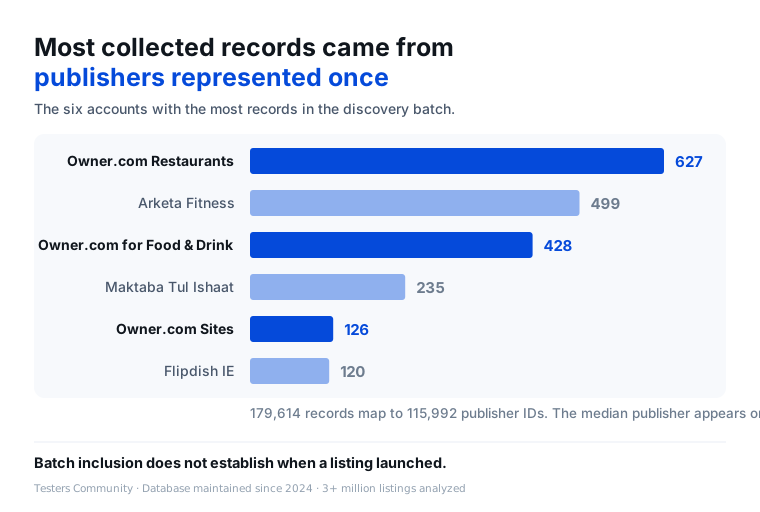
These counts show representation in the discovery batch. They do not prove that the publishers launched those apps during the week. The same discovery-versus-launch distinction applies at publisher level.
Discovery batches over time
The table is designed to accept comparable future batches, but the current local evidence contains one row. It should therefore be read as a dated batch record, not a time series or a weekly average.
| Batch date | Discovered IDs | Collected records | Collection failed | Failure share | Publishers | Under 1,000 installs | Shows a rating | Games |
|---|---|---|---|---|---|---|---|---|
| 23 Aug 2026 | 250,952 | 179,614 | 71,338 | 28.4% | 115,992 | 92.6% | 1.9% | 21.1% |
About this data
Testers Community built and maintains the Google Play listing database used for this analysis. The discovery batch is stamped 23 August 2026 and its aggregate is dated 31 August 2026. The batch contains 250,952 previously unseen app IDs, with 179,614 collected records and 71,338 collection failures.
The store-wide comparison uses 3,037,501 unique app-ID records observed between 27 July and 25 August 2026. Percentages for listing fields use the relevant collected-record base. Release-date shares exclude records without a release date. See How We Count Google Play Apps for the identifier, deduplication and denominator rules.
How to read these findings
- Typical weekly volume. One batch cannot establish an average, trend or normal range.
- Launch dates. First discovery by our database is not the same as first publication on Google Play.
- Why collection failed. The aggregate provides a counter, not a verified cause for each failure.
- Future performance. Install, rating and media fields describe the collection date, not what happened afterward.
- Complete store coverage. IDs absent from the discovery source and historical database are outside this count.
Frequently asked questions
Did 250,952 apps launch on Google Play in one week?
No. Our database discovered 250,952 previously unseen app IDs in the batch dated 23 August 2026. Discovery is not the same as launch: some successfully collected records carried older release dates.
How many records were collected successfully?
The collector saved 179,614 listing records from the 250,952 discovered IDs. Collection failed for the remaining 71,338 IDs, or 28.4% of the batch.
Does a collection failure mean an app was removed?
No. The saved counter establishes only that collection did not produce a record. It does not identify the cause and is not evidence of a developer removal, policy removal or delisting.
What did the collected listings look like?
Among the 179,614 collected records, 92.6% were under 1,000 lifetime installs, 1.9% showed a star rating, 21.1% were in a game category and 3.8% linked a promo video.
How complete were the collected store listings?
The collected batch had a median description length of 1,245 characters, a median of 7 screenshots and a median of 7 declared permissions. These are listing characteristics, not quality scores.
How many publishers appeared in the batch?
The 179,614 collected records contained 115,992 publisher IDs. Publisher counts describe representation in the discovery batch and do not establish how many apps those publishers launched during the week.
Citing this research
Testers Community, Google Play App Discovery: One Weekly Batch in 2026, September 2026. Discovery batch dated 23 August 2026: 250,952 previously unseen app IDs, 179,614 collected records and 71,338 collection failures. Store-wide comparison based on 3,037,501 unique app-ID records observed from 27 July to 25 August 2026.
Copy a reference
- Plain
- Testers Community (2026). Google Play App Discovery: One Weekly Batch in 2026. https://www.testerscommunity.com/research/how-many-apps-launch-weekly
- APA 7
- Testers Community. (2026, September 16). Google Play app discovery: One weekly batch in 2026. https://www.testerscommunity.com/research/how-many-apps-launch-weekly
- MLA 9
- “Google Play App Discovery: One Weekly Batch in 2026.” Testers Community, 16 Sept. 2026, www.testerscommunity.com/research/how-many-apps-launch-weekly.
- In an article
- according to Testers Community’s dated Google Play discovery-batch analysis (September 2026)
When quoting 250,952, call it previously unseen app IDs in one dated discovery batch, not weekly launches.
Sources
- Publish your app, Google Play Console Help
- Metadata, Google Play Console Help