
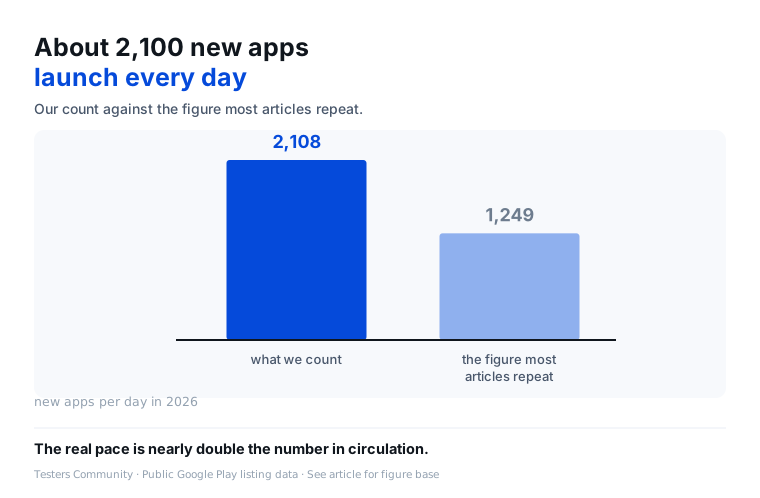
Search this question and nearly every result agrees on the same figure: 1,249 new apps a day. Almost none of them says where it comes from. So we measured it ourselves, across 3M+ listings in our data this summer, and the real pace in 2026 is about 2,100 new apps every day. Here is the math in full, the ten-year trend behind it, and what a flood this size means for the one app you are about to ship.
The short answer
About 2,100 new apps launched on Google Play every day of 2026, by our count. The math is open: 499,548 of the apps in our data carry a 2026 release date, and the data ran to 25 August. Every bias we can name, undated listings, apps we never reached, apps delisted before we arrived, pushes the true figure higher. The pace has nearly doubled since 2024, and this page shows what that means for a single launch.
Where does 2,100 a day come from?
From the release dates shown on observed listings. Of the 3M+ listings in our data, 2,311,689 carry a release date. Of those, 499,548 fall in 2026, and the data ended on 25 August, day 237 of the year.
Divide the releases by the days and you get 2,108 new apps a day. We round it to about 2,100, because the last digits imply a precision the data does not have. That single division is the entire method, and the figure below walks through it.
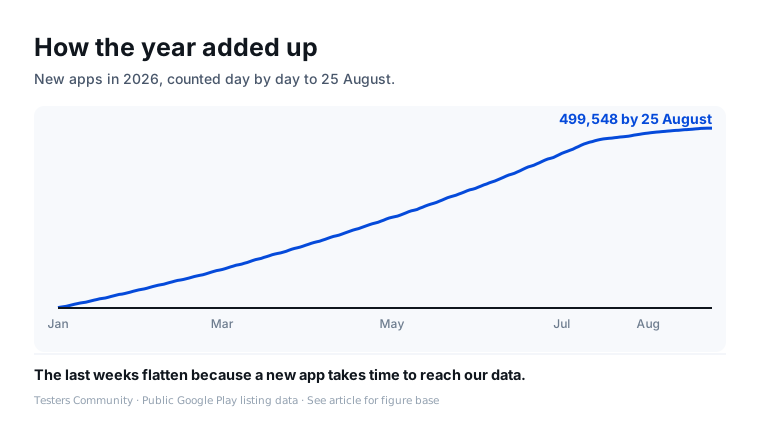
Every known gap in the count runs the same way. 23.9% of the apps in our data have no date, so none of them are in the numerator. Apps that launched in 2026 and were delisted before then are missing too, and so is anything not in our data. 2,100 is the floor, not the ceiling.
Why do other articles say 1,249?
Because they quote each other. The 1,249-a-day figure has circulated for years, usually with no method, no date range and no base attached. Repeat a number often enough and it stops being checked.
The writers are not the problem; a stale estimate is. Dated releases in our data grew every single year since 2016, so a daily figure without a year attached does not describe anything. It is a number that used to be true, if it ever was.
Ours will go stale too, which is why the method matters more than the result. Take dated releases, divide by days elapsed, and say what the count misses. Anyone can run the same count and check us, and we would welcome it.
How fast is the pace rising?
Fast enough that the acceleration, not the count, is the real story. The 499,548 releases dated 2026 already beat every full year in our data, with four months still to run. All of 2024 produced 260,003, so eight months of 2026 nearly doubled it.
The full ladder is below, and it only moves one way. Every year out-shipped the year before it, and the last two steps are the steepest.
| Release year | Dated releases in our data | Per day |
|---|---|---|
| 2016 | 49,713 | 136 |
| 2017 | 68,445 | 188 |
| 2018 | 82,923 | 227 |
| 2019 | 100,101 | 274 |
| 2020 | 138,061 | 377 |
| 2021 | 153,630 | 421 |
| 2022 | 203,635 | 558 |
| 2023 | 252,564 | 692 |
| 2024 | 260,003 | 710 |
| 2025 | 399,738 | 1,095 |
| 2026 (to 25 Aug) | 499,548 | 2,108 |
Read the early years with care, because this is a snapshot of what survives, not a registry of what launched. Apps released in 2016 had a decade to be delisted before we arrived, so the old totals undercount their real launch years. The chart tracks release years among listings still observable in our study, not the complete number of apps launched in each year.
What happens to today's 2,100?
Mostly, silence. Of the 2026 releases in our data, 96.4% show no rating at all. Google Play only displays a score once an app collects enough ratings, so a day's class of launches goes up almost entirely starless.
Install counts read the same way. 84.5% of the apps released in 2026 are still under 1,000 lifetime installs. That share improves as a class ages. But less than you would hope: most of the 2023 class is still under the same line today.
None of this says today's launches are bad apps. It says the default outcome of a launch is quiet, because roughly 2,100 pages went live today and attention did not grow to match. Whatever separates the exceptions, it is not luck of the calendar.
What does this mean for your app?
You cannot out-shout a flood, so do not plan to. Launch day puts you in a class of about 2,100, and the store will not introduce you to anyone. The apps that escape the default outcome tend to arrive with momentum already started: users recruited before launch, first feedback handled, a listing built to convince a stranger.
Google has already scheduled the rehearsal for you. A new personal account must run a closed test with 12 opted-in testers for 14 continuous days before it can apply for production access. That is two weeks of real people using the app while changes are still cheap, before your page joins the daily flood.
About this data
Every figure on this page comes from the Google Play listing database Testers Community has built and maintained since 2024. This 2026 study analyzes 3,037,501 listings observed from 27 July to 25 August 2026. What counts as an app, what is excluded and how percentages are based is set out in how we count Google Play apps.
Per-year and per-day figures are computed over the 2,311,689 listings that carry a release date, and we say "dated releases" wherever that smaller base applies. Days elapsed for 2026 is 237, counting 1 January through 25 August.
How to read these findings
- Study population. Every figure is a share of the 3M+ listings in our data, never a share of the whole Play Store, whose total Google does not publish.
- Not a launch registry. We count what survives to be in our data. Apps delisted before our window are missing, which undercounts every year, the old ones most of all.
- Undated listings are excluded. 23.9% of the apps in our data carry no release date and sit outside every per-year figure on this page.
- Not Google's number. Google publishes no daily release or submission counts. Ours is measured from public listing pages, not from Play Console, and the two could differ.
- Current study snapshot. Our database has been maintained since 2024. We measured every app once, in one window. The trend compares surviving launch classes of different ages, not one set of apps through time.
Frequently asked questions
How many new apps launch on Google Play every day?
About 2,100 a day in 2026, measured across the 3M+ listings in our data. 499,548 of them carry a 2026 release date and our data runs to 25 August, which works out to 2,108 a day. Every bias in the count runs upward, so treat 2,100 as the floor.
Where does the 1,249 apps per day figure come from?
From older estimates repeated between articles, usually with no method, no date range and no base attached. Our 2026 figure is about 2,100 a day, measured from release dates on 3M+ listings, and the method is shown in full so you can check it.
How many apps were released on Google Play in 2026?
499,548 of the apps in our data carry a release date in 2026, counted up to 25 August. That already beats every full year in our data, including the 399,738 of 2025, with four months of the year still to run.
Is the number of new Android apps rising?
Yes, every year in our data out-shipped the year before it. Dated releases climbed from 49,713 in 2016 to 399,738 in 2025, and the first eight months of 2026 added 499,548 more. Part of the early-year gap is survivor bias, because delisted apps are missing, but the direction is unambiguous.
What happens to apps after they launch on Google Play?
Mostly silence at first: 96.4% of the 2026 releases in our data show no rating, and 84.5% are still under 1,000 lifetime installs. The default outcome of a launch is quiet, which is why the pre-launch work matters more than launch day itself.
Does Google publish how many apps launch daily?
No. Google does not publish daily release or submission counts, which is why the same estimates circulate for years unchecked. Our figure is measured from the listings themselves: dated 2026 releases divided by days elapsed.
How accurate is the 2,100 apps a day estimate?
It is a floor. 23.9% of the apps in our data carry no date, apps delisted before then are missing, and no dataset reaches everything. All three gaps would raise the figure, not lower it.
Citing this research
The Google Play listing database behind this paper has been built and maintained by Testers Community since 2024. Testers Community, About 2,100 Apps Launch on Google Play Each Day, August 2026. Based on 3,037,501 listings in the current study, observed from 27 July to 25 August 2026, of which 2,311,689 carry a release date. When you quote a figure, keep the base and the data window with it, because both change what the number means.
Copy a reference
- Plain
- Testers Community (2026). About 2,100 Apps Launch on Google Play Each Day. https://www.testerscommunity.com/research/how-many-apps-launch-daily
- APA 7
- Testers Community. (2026, October 7). About 2,100 Apps Launch on Google Play Each Day. https://www.testerscommunity.com/research/how-many-apps-launch-daily
- MLA 9
- “About 2,100 Apps Launch on Google Play Each Day.” Testers Community, 7 Oct. 2026, www.testerscommunity.com/research/how-many-apps-launch-daily.
- In an article
- according to Testers Community’s analysis of 3,037,501 Google Play listings (August 2026)
- HTML link
<a href="https://www.testerscommunity.com/research/how-many-apps-launch-daily">Testers Community, About 2,100 Apps Launch on Google Play Each Day (2026)</a>
Reuse the figures and the table. Everything on this page is free to republish under CC BY 4.0. Keep the source line that is drawn on each figure, and link this page as the source. Each element has its own address so you can point at exactly what you quote: figure 1, figure 2 and the data table.
Need a different cut of the data, a comment for an article, or a figure sized for your page? Write to support@testerscommunity.com and say which page you are citing.
Sources
- Publish your app, Google Play Console Help
- App testing requirements for new personal developer accounts, Google Play Console Help